How To Use Alva's Product Selector: A Step-by-step Guide
A step-by-step guide to finding the right SlimTorq™ motor for your application. Alva’s SlimTorq™ motor series offers a wide range of sizes and winding configurations to meet the demands of advanced motion control applications. To help engineers efficiently navigate these options, we provide an intuitive Product Selector tool directly on our website.
February 12, 2026
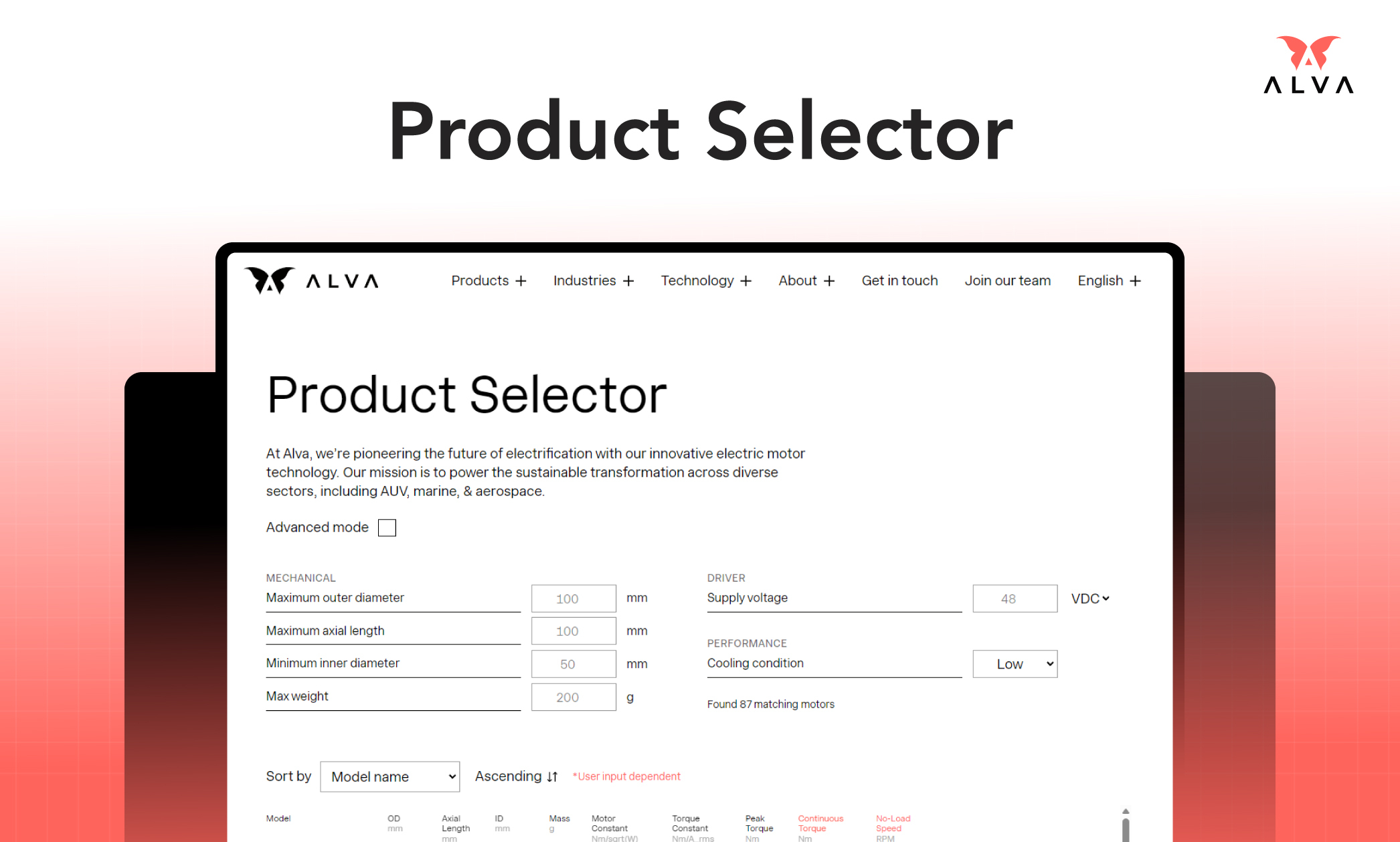
1. Where to Find the Product Selector
You can access the full SlimTorq™ product catalog and datasheets under:
Products → SlimTorq™ Motors
Directly below the product overview, you will find the Product Selector tool, designed to help you filter through available motor configurations based on your application requirements.
2. Understanding the Two Modes
The Product Selector offers two filtering modes:
Basic Mode
Designed for quick and efficient filtering using core system constraints such as:
- Outer diameter
- Length
- Mass
- Supply voltage
This mode is ideal for early-stage feasibility assessments.
Advanced Mode
Provides additional filtering parameters for deeper optimization, including:
- Continuous torque
- Continuous current
- No-load speed
- Electrical limits
Advanced Mode is recommended when performance targets are clearly defined and system-level trade-offs must be evaluated.
3. Example: Filtering Motors in Basic Mode
Let’s consider a project with the following constraints:
- Maximum outer diameter: 80 mm
- Maximum length: 25 mm
- Maximum mass: 300 g
- Supply voltage: 24 V
After entering these values, the results table automatically updates to display only motors that meet the defined criteria.
Understanding the Results Table
The results table includes key motor parameters such as:
- Mechanical dimensions
- Motor constant (Km)
- Torque constant (Kt)
- Torque values
- No-load speed
The table can be sorted by any column.
For example, if maximizing torque efficiency is critical, you can sort by motor constant (Km) to identify the most efficient solution within your constraints.
In this example scenario, the STM-75-20 Max with 8Y winding emerges as the most suitable option after sorting.
4. Evaluating Continuous Torque
On the right-hand side of the selector, you can see the expected continuous torque at the selected cooling level.
This value can be adjusted depending on your thermal conditions.
If the available continuous torque does not meet your system requirements, further filtering is required - this is where Advanced Mode becomes essential.
5. Using Advanced Mode for Performance Optimization
When switching to Advanced Mode, additional fields become available.
For example, you can:
- Define a minimum required continuous torque.
- Set a maximum continuous current.
- Specify a minimum no-load speed.
Dynamic Parameter Behavior
Certain parameters adapt automatically based on your inputs:
- Maximum speed depends on the selected supply voltage.
- Current draw depends on the required torque.
This dynamic behavior allows you to:
- Understand system trade-offs.
- Evaluate electrical and thermal feasibility.
- Optimize for performance or efficiency.
If no motors match your criteria, consider adjusting limiting parameters (such as outer diameter or torque requirements) to explore alternative solutions.
6. Finalizing Your Motor Selection
Once you identify the motor that best fits your requirements, you can:
Download CAD Files
Access 3D models directly from the platform for immediate integration into your mechanical design.
Configure the Motor
Enter Configuration Mode to:
- Finalize winding options.
- Complete the motor type code.
After adding your contact details, you can directly request a quote.
7. Best Practices When Using the Product Selector
To get the most accurate results:
- Start with hard physical constraints (diameter, length, mass).
- Then optimize for performance (torque, speed, efficiency).
- Review continuous torque under realistic cooling assumptions.
- Use Advanced Mode to validate electrical limits.
- Revisit constraints if no results appear.
8. Need Assistance?
While the Product Selector is designed for ease of use, motor selection can sometimes require deeper system-level evaluation.
If you have questions or need support identifying the best SlimTorq™ motor for your application, our application engineers are available to assist. Contact us at: https://www.alvaindustries.com/contact

All rights reserved ©2026