Frameless Motors Integration with Gears: Design Methodologies for Compact Geared Actuators
Learn how integrating frameless slotless motors with different gear topologies enables more compact, torque-dense actuators. This guide explores planetary, strain wave, cycloidal, and ball screw systems, along with the key engineering considerations for designing high-performance motion systems.
August 20, 2026
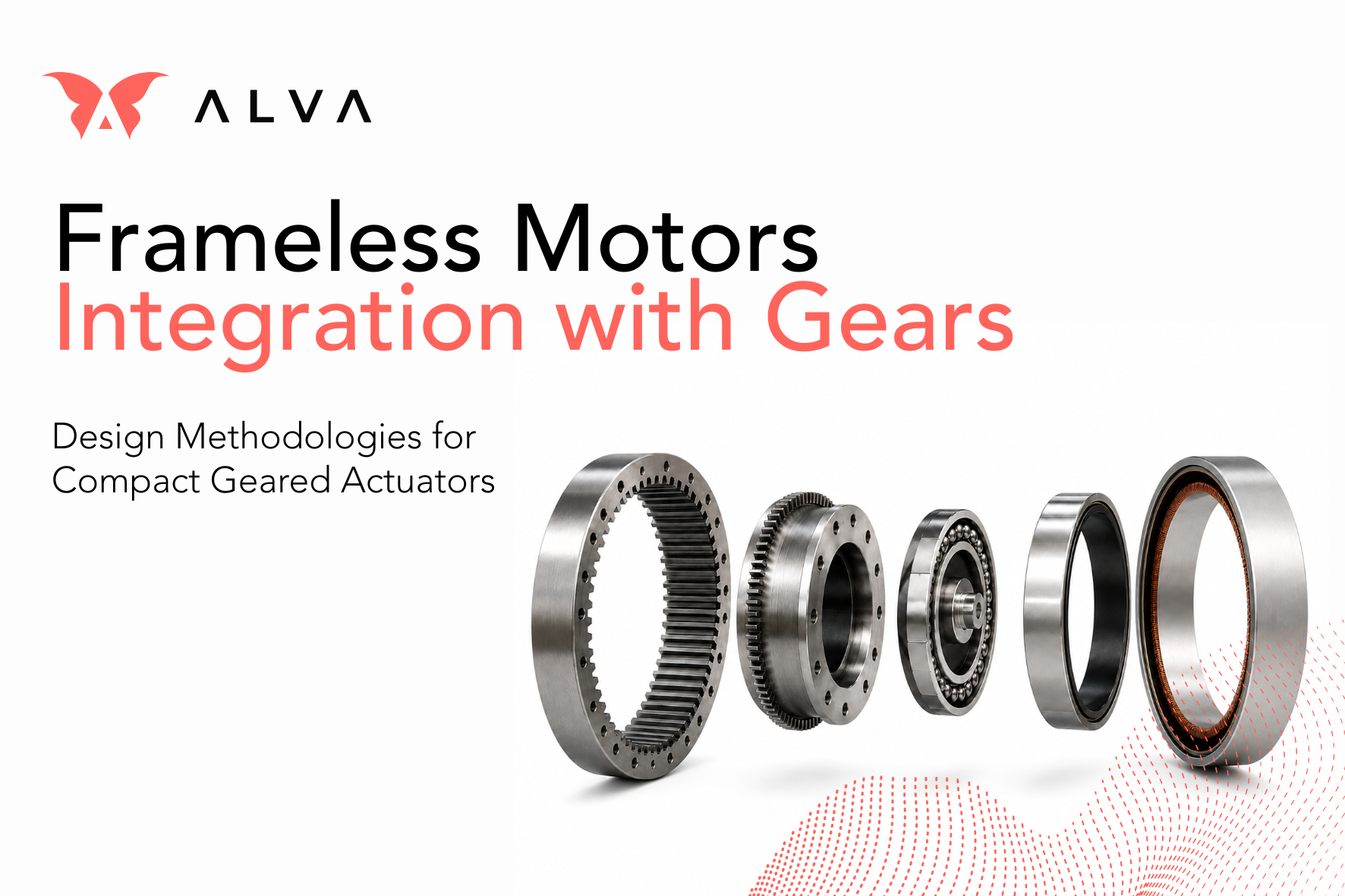
When designing a motion control application, engineers must navigate a complex web of specifications and constraints. While application requirements dictate the necessary speed and torque, physical boundaries are strictly defined by volume, weight, and size limitations. Minimizing component count is always ideal to reduce both complexity and cost; however, direct-drive solutions eventually reach a physical threshold where they become too large to deliver the required torque.
This is where gearing becomes relevant. Integrating a gearbox multiplies the motor's output torque, eliminating the need for a larger, heavier motor. Although this trade-off reduces output speed, it is a highly acceptable compromise for many applications. Designing with a frameless motor already requires navigating intricate technical decisions, and introducing a gear stage increases that complexity. Nevertheless, by approaching the integration of these components systematically, engineers can successfully develop a highly efficient, compact, and extremely torque-dense system.
Evolution of Compact Motion Control - Why does it matter now?
The evolution of compact motion control is rapidly accelerating toward extreme miniaturization without sacrificing performance. Across high-stakes industries -including robotics, medical devices, and aerospace - the demand for smaller, lighter, and highly integrated systems has reached an all-time high and shows no signs of peaking anytime soon. To meet these stringent requirements, design engineers are shifting away from bulky, traditionally housed motors towards frameless alternatives.
Consisting solely of a separate rotor and stator, frameless motors integrate directly into a machine’s mechanical structure, such as a robotic joint or surgical tool. This direct integration eliminates redundant components like couplings, bearings, and auxiliary housings, drastically reducing both the system's overall footprint and its mass. In line with this, the industry's primary focus has been on maximizing torque density - delivering the absolute highest torque possible within the smallest available spatial envelope.
.png)
Combination of a Slotless Frameless Motor with Gears - New Possibilities
Even until now the space and mass savings of integrating a frameless motor, to make actuators more compact and lighter, were quite significant. Using a frameless motor and gearbox, integrated in series, increases complexity and the balance between the savings and the overall complication seems to pay off only in selected cases.
The evolution of compact motion control has achieved a powerful synergy by pairing large inner-diameter motors with centrally integrated gearing. The core advantage of this architecture lies in its radical efficiency of space usage. Eliminating the conventional "stacked" configuration - where the motor sits axially behind the gearhead - dramatically reduces the actuator’s overall length and weight. This has traditionally been realized with slotted outrunners, with significant challenges related to thermal dissipation and integration complexity.
This is where the FiberPrinting™ process plays an important role. This revolutionary method of producing ironless and slotless copper windings generates a highly compact stator with a high fill factor. This stator is then paired with a Halbach array rotor, resulting in a frameless motor with superior torque density, that can even compete with slotted counterparts. The result is now a super thin inrunner frameless motor that allows gearboxes to be integrated inside the frameless motor. This not only allows for a highly compact and light actuator, but due to the nature of a slotless motor design, many other features come along (zero cogging, torque linearity, no torque saturation etc.), while keeping the same performance. Furthermore, Alva’s slotless motors do not suffer from magnetic saturation, enabling them to reliably deliver the high peak torques required for dynamic load cases. Lastly, since Alva’s motors are inrunners, the stator sits on the outside, which is beneficial for packaging and thermal aspects.
Gear alternatives
The selection of a specific gear topology to pair with a frameless motor depends heavily on the overarching system requirements. Because different gearing technologies offer distinct advantages and trade-offs, the optimal choice is dictated by the specific needs of the application. Here is an overview of the primary gearing alternatives typically utilized in these designs.
Planetary
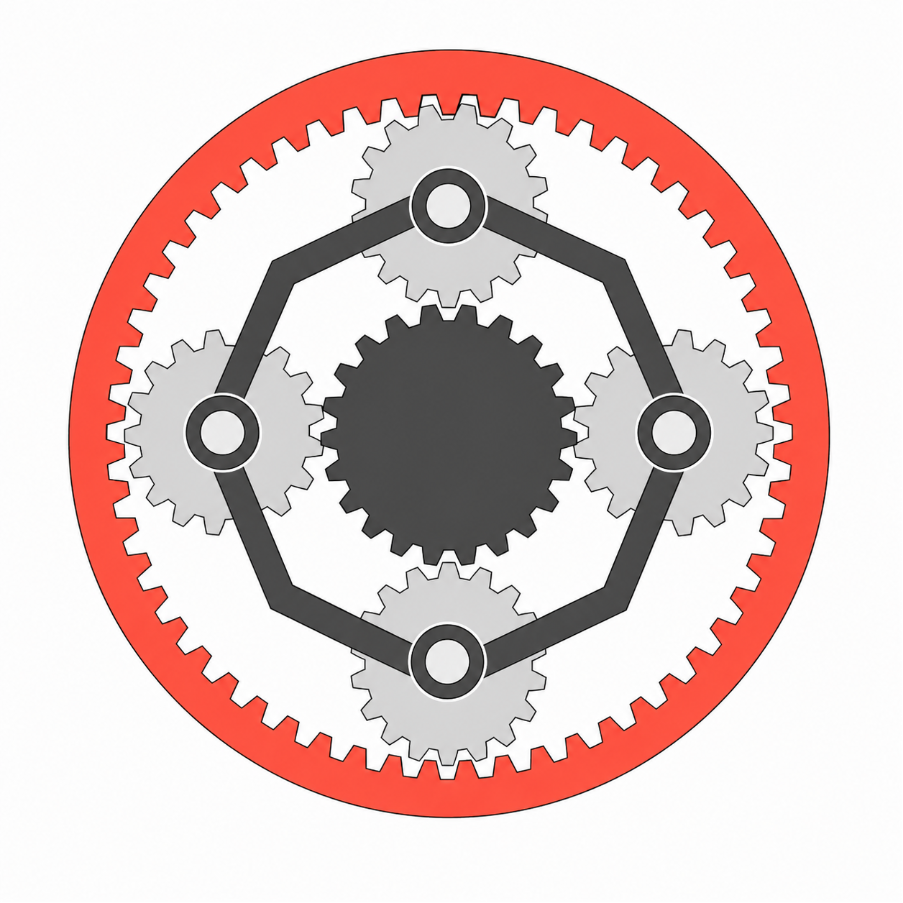
A planetary gear is an epicyclic gearing system consisting of a central input gear (the sun gear) surrounded by orbiting driven gears (planet gears) that interface with an outer ring gear. Depending on the required reduction ratio, the system can be configured as a single-stage or stacked into multiple stages.
Advantages:
- High Torsional Stiffness & Load Distribution: Because the mechanical load is distributed across multiple planet gears simultaneously, the system exhibits exceptional torsional stiffness.
- Shock Load Resilience: This load-sharing architecture allows planetary gears to withstand sudden shock loads effectively.
- High Efficiency & Torque Density: They can be engineered to deliver excellent torque density alongside high-speed efficiency.
Limitations:
- Backlash: Planetary systems inherently suffer from mechanical backlash, which can impact precision.
- Axial Length: Achieving higher gear ratios requires stacking multiple stages, which increases the overall axial length of the actuator.
Typical Applications:
Planetary gears are widely utilized in applications such as aerospace actuators, humanoid robotics, Automated Guided Vehicles (AGVs), and high-speed pick-and-place systems.
Traditional Planetary gear and Motor combinations:
Typically, an actuator made with Planetary gears delivers high speed, torque density, and back-drivability. However, it suffers from mechanical backlash, and stacking stages for higher torque increases axial length, requiring secondary feedback for ultra-precision.
New possibilities for Planetary gear actuators with Thin section motors:
With Alva's thin section motors, the gear’s axial length is mitigated by the compact shape and large inner bore, that allows the gear to be placed in the motor’s centre. The slotless design eliminates cogging to ensure ultra-smooth rotation and optimizes high-speed efficiency. The large peak torque capabilities allow for reduced gear ratios and increased back-driveability for the actuator.
.png)
Strain wave (Harmonic drives)
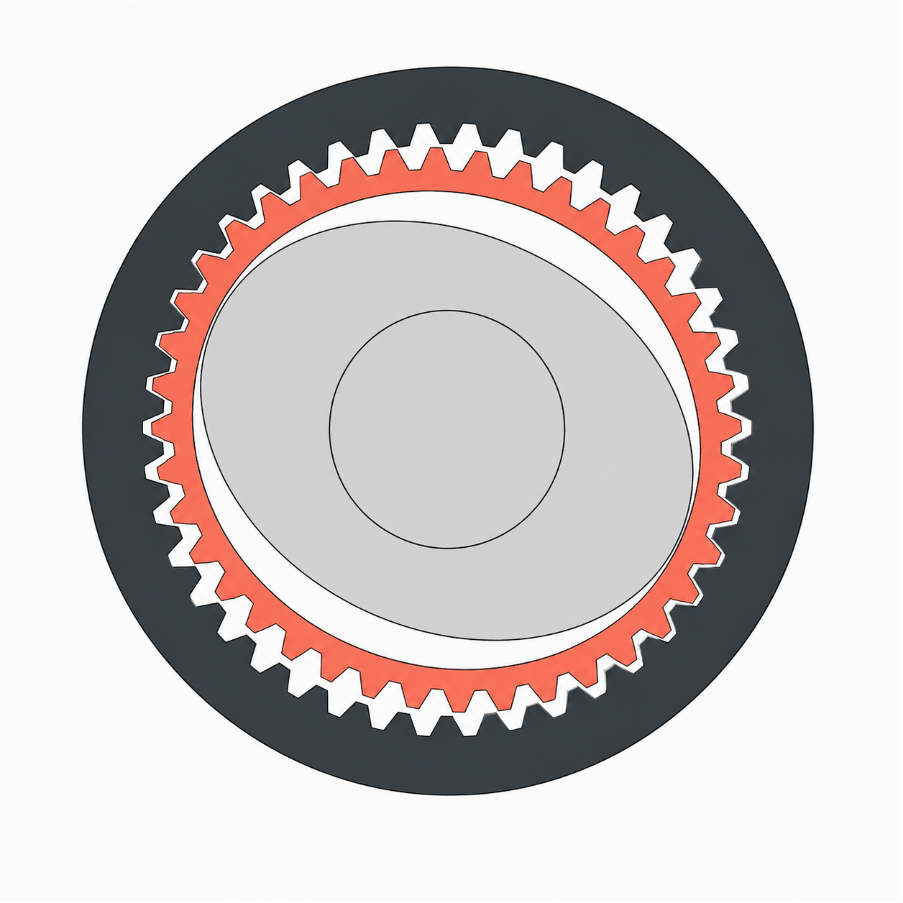
A strain wave gear consists of three core components: an elliptical wave generator, a flexible splined cup with external teeth (flexspline), and a rigid outer ring gear (circular spline). As the wave generator rotates inside the flexible cup, it deforms it to engage with the outer ring gear. This unique mechanism creates a highly compact, single-stage system capable of achieving exceptionally high reduction ratios.
Advantages:
- Near-Zero Backlash: Because multiple gear teeth remain in continuous contact simultaneously, strain wave gears exhibit minimal to near-zero backlash, making them ideal for high-precision applications.
- High Single-Stage Ratios: It’s possible to achieve high gear reduction in a compact single-stage footprint.
- Integrated Hollow Bore: In addition to achieving high gear ratios in a single-stage, these systems frequently feature a large central hollow bore, allowing for the clean routing of cables and service lines.
Limitations:
- Reduced Stiffness: Due to the inherent flexibility of the internal components, strain wave gears lack the high torsional stiffness found in rigid gearing systems.
- Speed Restrictions: Thermal constraints and the mechanics of the flexible deformation can limit their performance at high input speeds.
Typical Applications:
Strain wave gears are the industry standard for precision robotic joints, surgical robots, and high-accuracy positioning gimbals, among other applications.
Traditional Strain wave gear and Motor combinations:
Typically, an actuator made with Strain wave gears delivers zero backlash, high torque density, and high single-stage reduction ratios in a compact axial footprint. However, it suffers from limited top speeds, torque ripple (velocity error), and high friction that reduces efficiency and limits back-drivability.
New possibilities for Strain wave gear actuators with Thin section motors:
With Alva's thin section motors, the actuator achieves an ultra-flat, pancake form matching the gear’s short axial length. The slotless design eliminates motor cogging to improve output smoothness, minimizes thermal losses at low speeds, and, if required, enables a large hollow shaft for clean, through-bore cabling.
.png)
Cycloidal
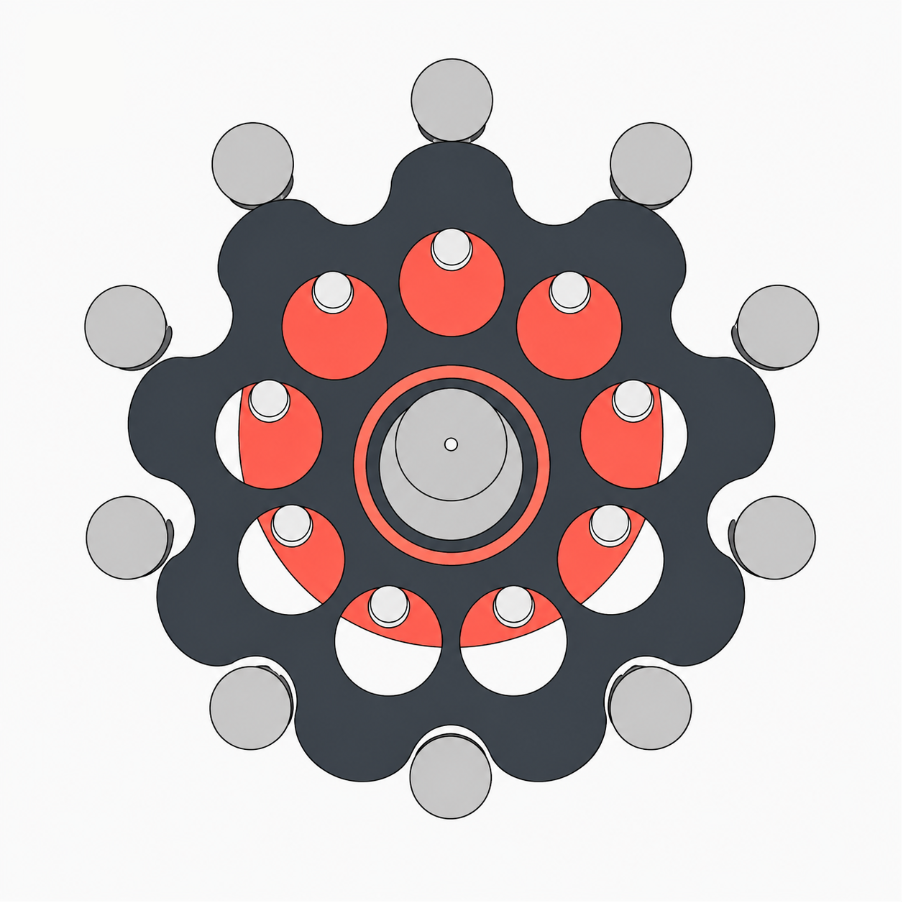
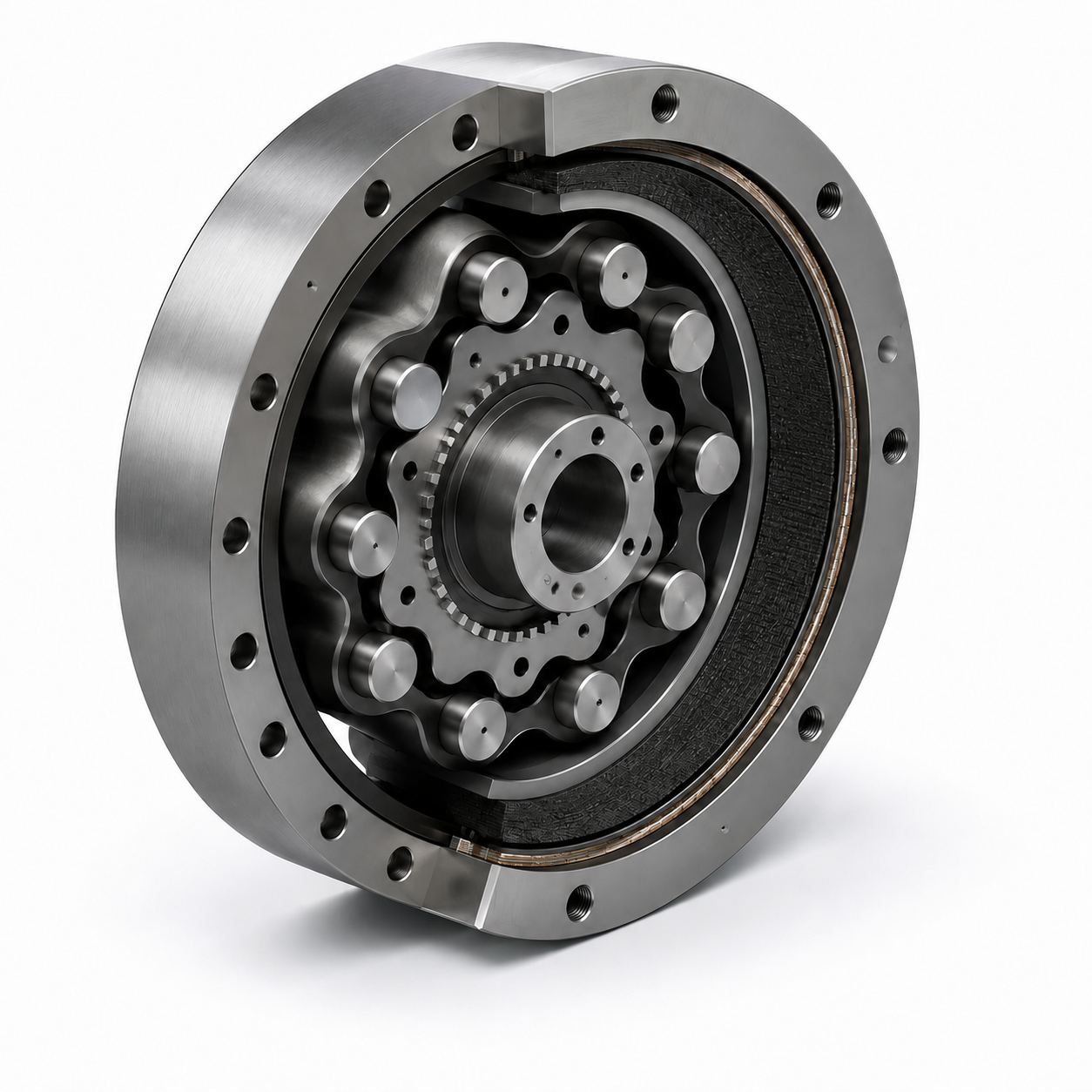
A cycloidal drive consists of an input shaft with an eccentric bearing or cam that drives a series of cycloidal discs. These discs roll inside a stationary ring of pins or rollers, engaging with an output shaft mechanism in a smooth, continuous motion. Because a high percentage of the load-bearing surfaces remain in contact simultaneously, the mechanism achieves exceptional load sharing.
Advantages:
- Superior Shock Load Resistance: The extensive load distribution across multiple contacting elements enables cycloidal gears to withstand extreme shock loads without catastrophic failure.
- High Single-Stage Ratios: They can achieve significant reduction ratios within a compact, single-stage footprint.
- Low Backlash: The rolling contact design inherently minimizes mechanical backlash, ensuring high positioning accuracy.
Limitations:
- Mechanical Complexity: The intricate configuration of eccentric cams, multiple discs, and precision rollers increases manufacturing complexity and component count.
- High-Speed Vibrations: Due to the inherent inertial forces of the eccentric rotating masses, cycloidal drives can suffer from considerable vibration at elevated speeds.
Typical Applications:
Cycloidal gears are ideally suited for high-impact environments, including lower-limb exoskeletons, heavy-duty mobile robotics, and high-precision industrial automation systems.
Traditional Cycloidal gear and Motor combinations:
Typically, an actuator made with Cycloidal gears delivers extreme shock load resilience, high torque density, and minimal backlash within a compact footprint. However, it suffers from internal eccentric vibrations at high speeds, complex manufacturing tolerances, and higher rolling friction that reduces overall efficiency and back-drivability.
New possibilities for Cycloidal gear actuators with Thin section motors:
With Alva's thin section motors, the actuator maintains a highly integrated, ultra-flat profile that mirrors the gear's short axial length. The slotless design eliminates cogging to maximize torque smoothness at low speeds, while the low high-frequency losses help mitigate heat generation when driving the gear's eccentric inputs. The compact motor shape enables this motor-and-gear combination even at small physical dimensions as there is more space for the gear.
Ball screws - Rotary to Linear movement
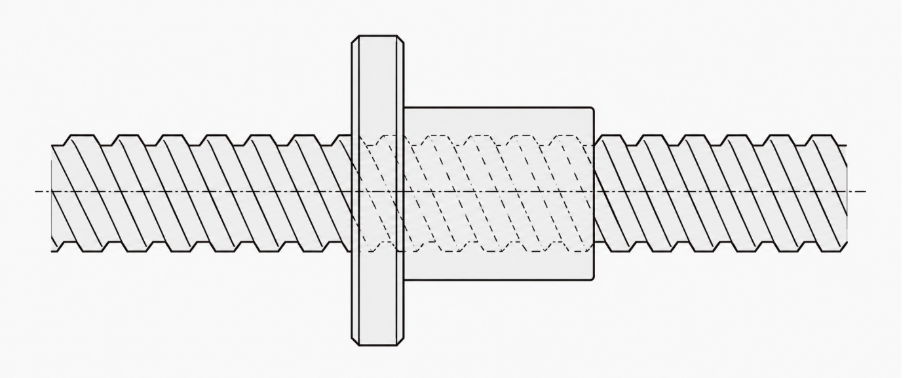
A ball screw is a highly effective mechanical actuator utilized to convert rotary motion from a motor into precise linear motion. The assembly consists of a precision-threaded shaft and a matching nut packed with recirculating ball bearings, which travel along the shaft to drive the linear load.
Advantages:
- High Mechanical Efficiency: Because the system relies on rolling elements rather than sliding friction, it offers exceptional mechanical efficiency and minimal power loss.
- Smooth Motion & Low Friction: The continuous rolling of the bearings ensures smooth, predictable linear translation with minimal stick-slip effect.
Limitations:
- No Centre Through-Bore: Unlike certain rotary gear topologies, ball screws cannot accommodate a hollow bore, which limits options for central cable routing.
- Speed Restrictions (Whip Effect): Long and slender ball screw shafts are susceptible to structural deflection and vibration at elevated speeds - a phenomenon known as screw whip - which places a strict ceiling on maximum velocity.
Typical Applications:
Ball screws are widely integrated into medical infusion pumps, aerospace flight control actuators, and high-precision optical or laser focusing stages.
Traditional Ball screw and Motor combinations:
Typically, an actuator made with Ball screws delivers exceptionally high linear force, precise positioning, and excellent efficiency with near-zero backlash. However, it suffers from limited linear speed, it strictly converts rotary motion to linear movement and requires significant axial length to accommodate the screw travel.
New possibilities for Ball screw actuators with Thin section motors:
With Alva's thin section motors, the actuator achieves an ultra-compact, rotary to linear configuration. The motor’s large hollow shaft allows the ball screw shaft to pass directly through the rotor, drastically reducing overall axial length, while the slotless design eliminates cogging to ensure ultra-smooth, sub-micron linear positioning.
.png)
General Key Considerations for the Mechanical Integration
When integrating a frameless motor with a gear set, several engineering and assembly factors must be addressed to ensure optimal actuator performance and long-term durability. The following list outlines the primary integration considerations and highlights key parameters to evaluate during the design phase:
- Air Gap Integrity & Concentricity: Frameless motors are engineered with tight tolerances, often featuring an air gap of only a few tenths of a millimetre. Maintaining absolute concentricity between the rotor and stator across all load scenarios - especially under the complex forces exerted on the gear set - is critical. Consequently, this heavily influences bearing selection and structural component design based on the application's specific load profiles. Furthermore, managing the radial air gap becomes significantly more challenging due to a more complex tolerance stack-up introduced by the increased number of interacting components.
- Thermal Management & Heat Dissipation: Because the gear set is typically integrated centrally within the inner diameter of the rotor, the thermal energy generated by frictional and mechanical losses inside the gearbox directly impacts motor temperatures. Balancing system performance requirements against the motor's operating temperature limits is critical. Specifically, designers must account for the fact that the rotor and its permanent magnets are more thermally sensitive and cannot withstand the same peak temperatures as the stator windings without risking demagnetization or degradation.
- Inertia Matching & Back-driveability: In a geared system, the reflected inertia of the load scales inversely with the square of the gear ratio, meaning the motor perceives the load inertia divided by n2 (where n represents the reduction ratio). Conversely, the rotor's inertia reflected to the output is amplified by a factor of n2. Optimizing the rotor-to-load inertia match - ideally targeting a 1:1 ratio for maximum dynamic performance - while simultaneously ensuring the system remains back-driveable presents a significant design challenge. The ideal balance depends heavily on the system's dynamic motion profiles and the specific degree of back-driveability required by the application.
- Vibration Mitigation & Structural Dynamics: Introducing a gear set inherently increases the acoustic and mechanical vibration profiles within a motion control system. Ensuring that all rotating components are dynamically balanced and that structural housings are designed with appropriate stiffness is critical to mitigating these unwanted harmonics. Proper component alignment and precise manufacturing tolerances are essential to minimize cyclic excitation and maintain system stability under load.
- Hollow Bore Optimization & Cable Routing: Integrating a gear set centrally within the rotor inherently constrains the available diameter of the through-bore. Depending on the selected gearing technology, varying degrees of hollow-bore capability can be achieved. Strain wave gears are generally the most accommodating for maintaining a generous centre aperture while achieving high reduction ratios. Planetary gears can also be engineered to support a hollow bore, though this configuration typically introduces greater mechanical complexity to route the internal pathways through the orbiting components.
- Lubrication Isolation & Seal Integrity: If the selected gearing requires lubrication, it must be robustly isolated from the motor cavity. Fluid migration into the narrow air gap would increase viscous drag, leading to parasitic power losses and efficiency drops. Furthermore, migrating lubricants can chemically degrade stator wire insulation - potentially causing electrical shorts - while a compromised seal may allow environmental dirt and wear debris to enter the magnetic air gap, risking abrasive damage.
- Dual Sensor Feedback & Precision Control: For applications demanding high positioning accuracy, implementing dual sensor feedback - with an encoder placed on each side of the gear stage - is highly recommended. This dual-loop configuration allows the control system to actively measure and compensate for mechanical backlash, torsional deflection, and other non-linearities inherent in the gearbox.
Customization Opportunities, GearTorq™ and Final Conclusions
Pairing a frameless, slotless motor with a correctly dimensioned gearing system provides an exceptional solution for applications demanding high power density within strict spatial or weight constraints. However, identifying the ideal off-the-shelf motor and gearbox combination can be a challenge, as the pairing is almost always a compromise between conflicting performance metrics. Standard components rarely align perfectly across torque, speed, and thermal limits, often forcing designers to accept suboptimal efficiencies or oversized packages. Utilizing a customizable motor platform solves this bottleneck, allowing engineers to tailor the motor’s winding and physical geometry to precisely match the gear set’s unique characteristics and optimize overall system performance.
FiberPrinting™ is a flexible manufacturing method that allows for customization of the motor. This means engineers can design an optimized actuator, derived from the application requirements and limitations, with available gear alternatives in mind, and not the other way around. This broadens the range of possible solutions, enabling the best choice for each project.
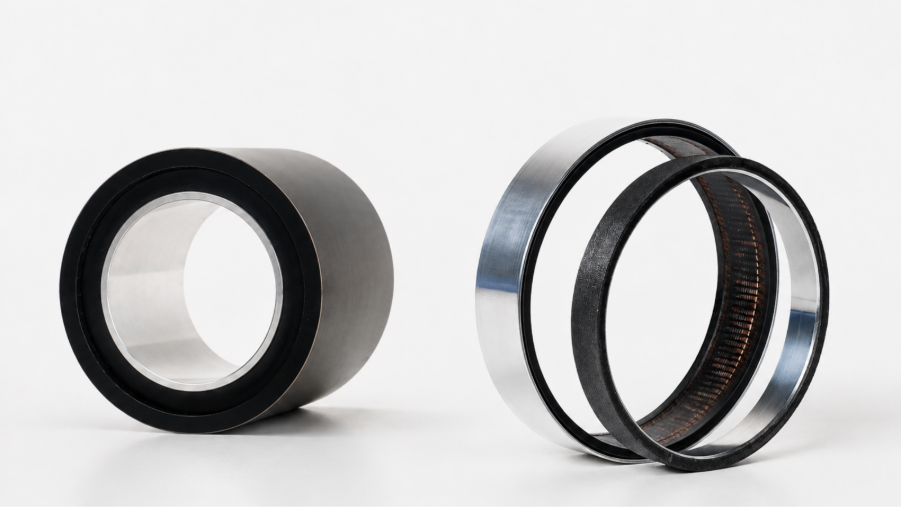
Alva also offers the GearTorq™ product line, which showcases longer motors compared to the SlimTorq™ range. With the same available compact form factor, and large inner diameter, GearTorq™ motors can be combined with different gear-topologies centrally placed inside the motor. Since most gear sets add a certain length to them, this available space is fully utilized by slightly longer motors.
If you’re designing a system and want to discuss possible solutions with our team, please contact us here.

All rights reserved ©2026